
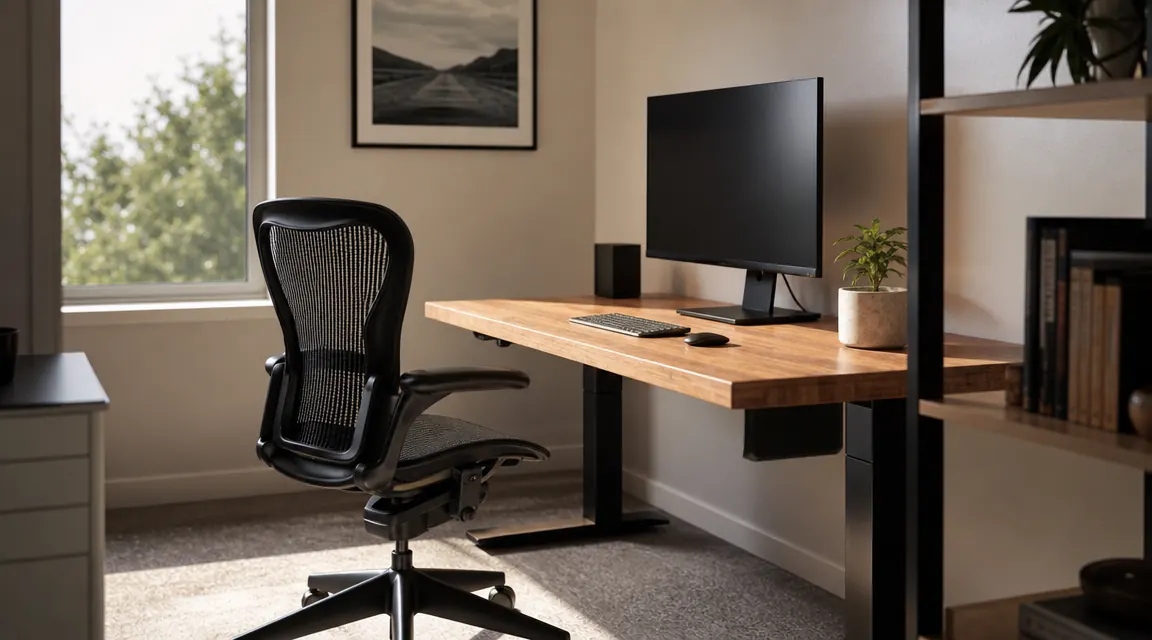
Let me tell you what was in the box that the product page did not mention. A bag of hardware with four different bolt sizes. A hex wrench that kept slipping before I reached full torque. An instruction sheet with diagrams small enough to read only if you hold it under a lamp. I sat on the floor of my home office for forty-five minutes putting together the HOLLUDLE ergonomic mesh chair, and I want to be upfront about that before I tell you everything else.
That caveat aside, the HOLLUDLE Ergonomic Mesh Chair is the chair I am sitting in right now, and it has been my daily driver for months. The 3D lumbar support is real, not a marketing phrase. The mesh breathes. The armrests adjust in more directions than I expected at this price. And when a friend lent me his Herman Miller Aeron for a week while he was traveling, I came back to the HOLLUDLE with a specific sense of what you get at $170 and what you give up compared to $1,400. That comparison is the part of this review I have not seen anyone else write, so I want to start there.
The Quick Verdict
Solid ergonomic chair at a fair price, but expect a real assembly commitment and a short break-in period for the mesh. The 3D lumbar delivers on its promise for most body types in the five-foot-three to six-foot-two range.
Amazon Check Today's Price →If your back is stiff by noon, this is the upgrade your office chair probably needs.
The HOLLUDLE ergonomic mesh chair has 3D lumbar adjustment, breathable mesh back, and 4D armrests. Over 6,400 verified buyers on Amazon. Check today's price below.
Amazon Check Today's Price on Amazon →The Herman Miller Comparison Nobody Pays For but Everyone Deserves
My friend Dan works at a design firm. His firm cleared the office for a short renovation and he got to bring his Aeron home. He offered to swap chairs with me for a week as an experiment, mostly because he was curious what a $170 chair felt like after years in a $1,400 one. I was curious about the other direction.
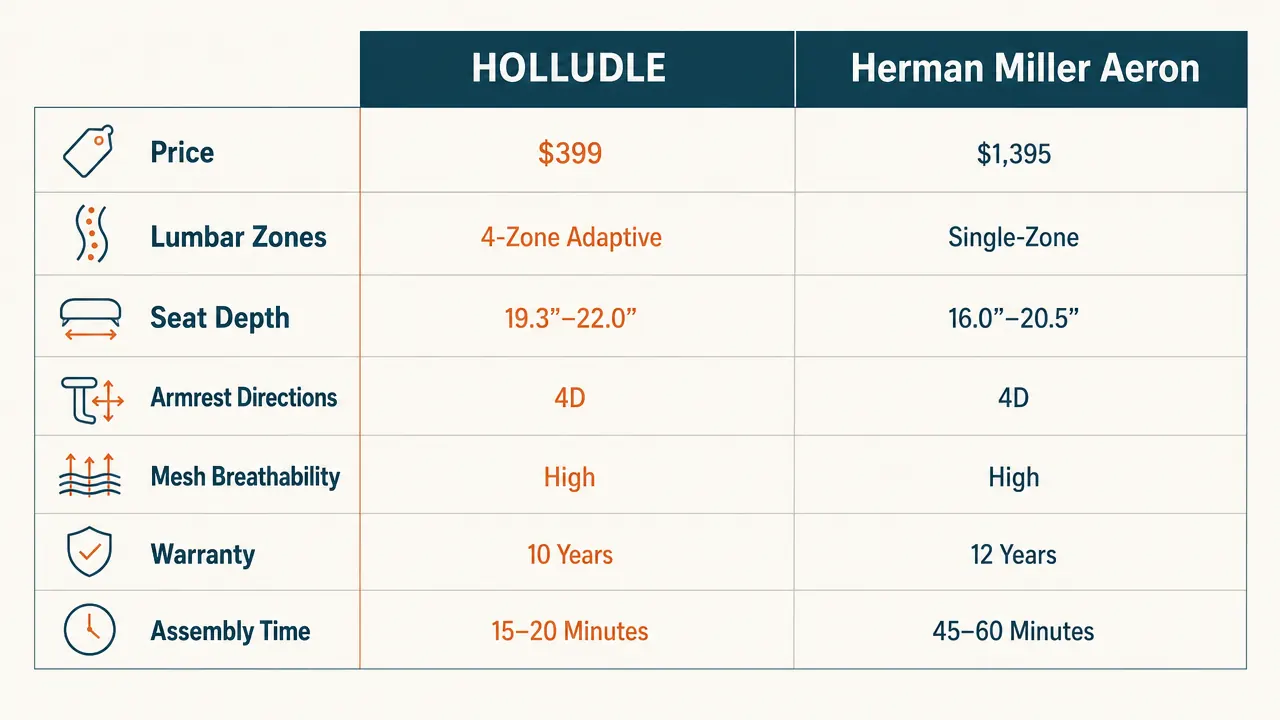
Here is what I found sitting in the Aeron. The PostureFit SL system cradles your sacrum and your lumbar separately, as two distinct contact zones. You feel that distinction immediately. It is as if the chair was shaped for your spine specifically. The HOLLUDLE lumbar hits one zone. Adjustable, yes, and the adjustment is meaningful. But it is one point of contact versus two. For most people working at a desk for five to eight hours, the single zone is enough. For someone with a diagnosed disc problem or chronic sacral pain, the Aeron's dual-zone support is a real difference, not a marketing one.
The mesh is also different in kind. The Aeron uses 8Z Pellicle mesh with eight distinct tension zones that flex with your body in a way the HOLLUDLE mesh does not quite match. That said, the HOLLUDLE mesh is genuinely breathable and taut enough to provide real support. The gap between the two chairs is noticeable if you sit in both within the same week. If you have only ever sat in budget chairs, the HOLLUDLE mesh will feel like a clear step forward.
My bottom line after that week: the HOLLUDLE gets you roughly seventy percent of what the Aeron provides, at about twelve percent of the price. If you sit for ten-plus hours a day, have employer reimbursement, or have a diagnosed back condition, the Aeron is worth it. If you are spending your own money and want a chair that is genuinely better than most of what you will find under $300, the HOLLUDLE is the right answer.
Assembly: What the Listing Calls 15 Minutes Is Actually 45
The listing says assembly is required. What it does not say is that the instruction sheet assumes you have assembled a chair before. The steps are illustrated but not dimensioned, so when you are looking at four sizes of bolt and two types of screw, you are matching by eyeball and feel. I seated one bolt partially before realizing it was binding, backed it out, and started that step again. That added ten minutes on its own.
Time budget: allow forty-five minutes if this is your first ergonomic chair assembly and about thirty if you have done it before. There is one step, attaching the lumbar support bracket to the seat back frame, that requires holding two components in alignment while threading a nut from the opposite side. On a workbench with a second pair of hands, it is nothing. On a floor alone, you will put it down at least twice. The instructions do not mention this. Several Amazon reviewers describe it as 'a little tricky,' which is charitable. Have an actual hex key set handy rather than relying on the included wrench, which will slip before the armrest bolts are fully torqued.
One reassurance: the gas lift cylinder will feel slightly loose in the base when you first put the chair together. This is normal. It seats fully the first time you sit down and compress the cylinder. If you assemble the chair, rock it side to side, and feel a small wobble, do not start pulling bolts. Sit down. It goes away.
The Headrest: Expect Two Rounds of Adjustment Before It Clicks
Out of the box I set the headrest to what looked like the right position, sat through a work session, and found the back of my skull pressing against the pad in a way that produced a low-grade annoyance rather than support. I tilted the angle forward and it improved immediately. Two days later I moved it up about an inch. That position is the one I have used since.
The lesson: do not judge the headrest on day one. The adjustability is genuine, the headrest itself is well-padded, and once it is dialed in, it provides real neck support during long sessions when your head wants to lean back slightly. But the right position requires a few days of minor iteration. Build that into your expectations. If you are under five feet eight and sit with completely upright posture rather than a slight recline, the headrest may not contact your neck at a useful height regardless of how you adjust it. The chair is proportioned around a taller reference body. Shorter users tend to benefit more from the lumbar and armrest features than the headrest.
The HOLLUDLE gets you roughly seventy percent of what a Herman Miller Aeron delivers, at twelve percent of the price. For most home office workers spending their own money, that math makes the decision for you.
The First Week: Mesh Creaks, What Causes Them, and When They Stop
For the first five to seven days, the mesh back produces a faint creak when you shift your weight or lean from upright to a slight recline. It is not loud. It is the sound of new mesh settling against the frame it is tensioned across. I noticed it most during the transition from sitting straight to leaning back. After about a week of regular use, it stopped entirely and has not returned.
I mention this because if you sit in a new HOLLUDLE on day one, lean back, and hear a creak, your instinct will be that something is structurally wrong. Nothing is wrong. It is a material break-in period that most taut mesh chairs go through. What does not go away is the click when you engage or disengage the tilt lock. That is not a break-in sound, it is how the mechanism operates. It is audible but not disruptive. The tilt itself is smooth and holds cleanly at several angles.

The 3D Lumbar: Does the Marketing Claim Hold Up?
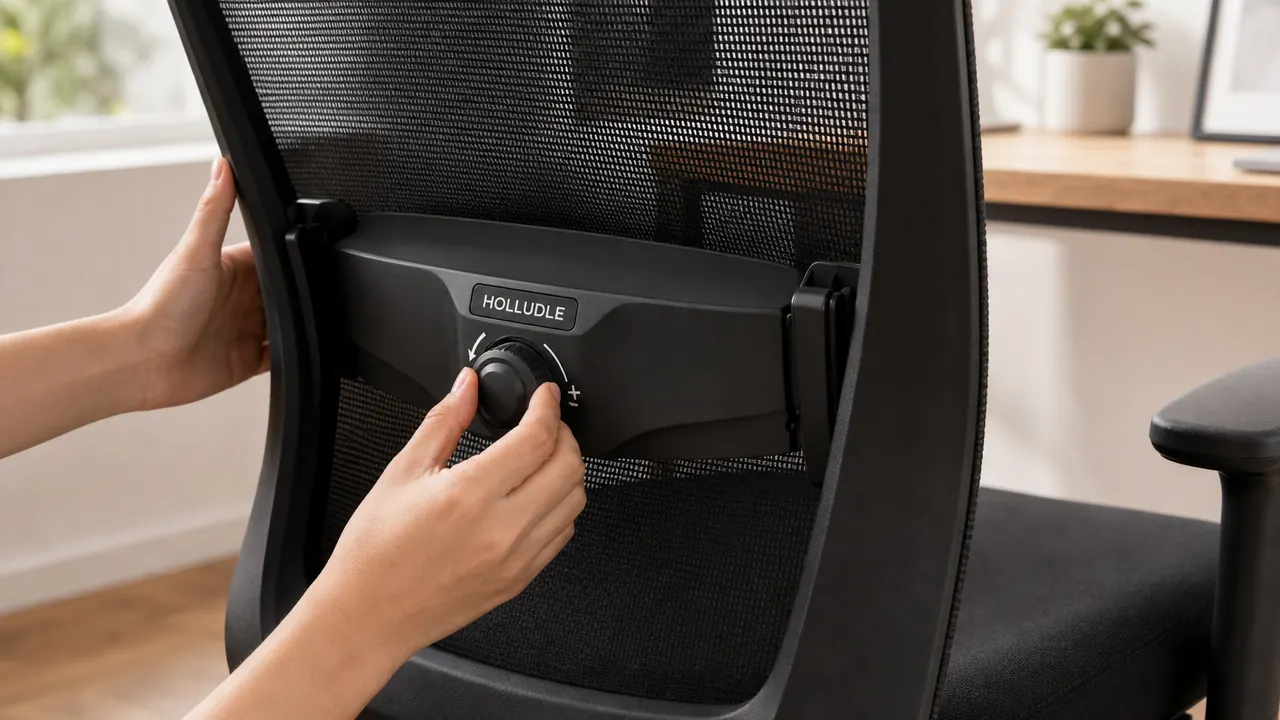
The HOLLUDLE is marketed primarily on its 3D adjustable lumbar. Three-dimensional adjustment in practice means you can move the lumbar support up and down a vertical track, push it deeper into or pull it back from your lower back via a dial, and the pad has a slight lateral flex that follows your movement. All three work. The up-down and depth adjustments are the ones that matter day to day.
The depth adjustment is the feature that separates this chair from most competitors at the same price. Budget chairs have a fixed lumbar bump. It either hits your curve or it does not, based entirely on your proportions. The HOLLUDLE dial lets you set how much pressure the lumbar pad exerts against your lower back. I dialed mine gradually over about three days from nearly all the way out to roughly two-thirds in. At that setting, after several months of use, I reach the end of a full workday without the lower back stiffness I used to carry into the evening. That is a repeatable, observable result, not a placebo.
One clarification on the 'three-dimensional' claim: the height and depth axes are clear. The third dimension is the natural lateral compliance of the pad when you shift your weight sideways. It is real but subtle. Do not go in expecting the pad to slide laterally like a powered system. Think of it as responsive flex rather than active lateral control. That is accurate to what the chair actually does.
Armrests, Seat Pan, and the Details That Do Not Make Headlines
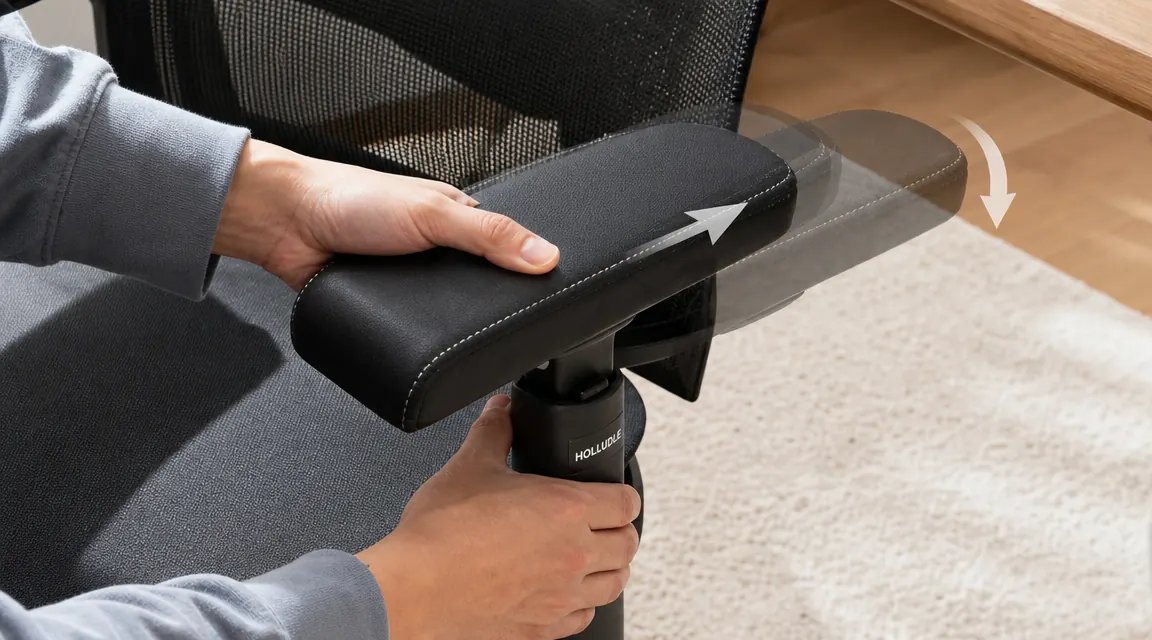
The armrests move up, down, forward, backward, and rotate inward and outward. For this price, that range is uncommon. I type with my elbows at roughly ninety degrees and the armrests land exactly where I need them. The padding is firm rather than soft. Firm padding keeps your forearms in a consistent position across a long session. Soft padding compresses and shifts, which means your elbow position drifts as the day goes on. Firm is the right call here.
The seat pan is 19.5 inches wide and about 18 inches deep. At five feet ten and average build, the seat fits without my thighs overhanging the front edge. For larger-framed or heavier-set adults, measure the seat width before ordering. The pan depth is the more significant constraint: taller people with longer femurs will find their knees extending past the front seat edge, which removes thigh support entirely. If you are six feet three or taller, the proportions of this chair work against you in both the seat depth and the gas lift height range. The lift tops out in a range that leaves very tall users sitting lower than ideal for standard desk height. This chair is built for people in the five-foot-three to six-foot-two range.
The casters roll well on hardwood and low-pile carpet. On bare hardwood they are slightly louder than I would prefer, but not enough to bother anyone in an adjacent room. The base is solid. After months of use there is no wobble at any joint.
What I Liked
- 3D lumbar depth adjustment is genuinely useful and easy to calibrate over a few days
- Mesh back breathes noticeably better than foam-padded alternatives on warm afternoons
- 4D armrests cover an unusually wide adjustment range for this price tier
- Initial mesh creak resolves completely after about one week of regular use
- Seat height range works well for adults between five feet three and six feet two
- Solid, rattle-free construction once fully assembled
Where It Falls Short
- Assembly takes 40 to 45 minutes and has one genuinely awkward step the instructions skip
- Headrest requires two or three days of micro-adjustment before the position feels correct
- Mesh creaks during the first week, which sounds alarming but is a normal break-in process
- Not the right fit for people over six feet three: seat depth, headrest height, and lift range all work against you
- Deep recline loungers will find the tilt range limited compared to chairs with a dedicated lounge mode
- One-year warranty is short relative to mid-tier and premium competitors
Who This Chair Is For
You work from home, you spend five to eight hours a day in this chair, and you are not in a position to justify spending $1,400 on an Aeron. You want a chair that adjusts to your back rather than the other way around. You are in the five-foot-three to six-foot-two range, average to medium build. You are willing to spend forty-five minutes on a real assembly and a few days dialing in the headrest. You run warm and want a mesh back that actually breathes. The HOLLUDLE is the right chair for you.
It is also a smart pick for anyone who has been skeptical of mesh because they assumed it meant flimsy. The back mesh on this chair is taut and supportive. It does not sag or stretch after months of use. If you work in a room without consistent AC and have sweated through your afternoon sessions in a foam chair, the difference in the first week will be obvious.
Who Should Skip It
If you are six feet three or taller, skip this chair. The seat depth does not accommodate longer femurs, the headrest sits too low for your natural neck position, and the gas lift height range leaves you sitting lower than your desk demands. There are taller-friendly ergonomic chairs at similar prices with better proportions for your frame.
If you are a deep recline person, someone who leans all the way back and uses their chair like a lounge between calls, this is also not your chair. The recline range is standard office-chair territory. There is no dedicated lounge mode or deep tilt position. And if you have a diagnosed lumbar or sacral condition that requires dual-zone support, the HOLLUDLE's single-zone lumbar is not a medical ergonomic chair. For that level of need, the Aeron or a Humanscale option is the appropriate step. The HOLLUDLE is a very good chair for everyday home office use, not a rehabilitation device.
One more practical note: if you live alone and hate assembly, factor in that one awkward step that benefits from a second pair of hands. It is not a showstopper, but it is the kind of thing that makes an otherwise manageable assembly feel frustrating when you are doing it alone on a floor.
Most chairs under $200 have a fixed lumbar bump. This one actually adjusts to where your back is.
The HOLLUDLE ergonomic mesh chair has 3D lumbar support, breathable mesh back, 4D armrests, and over 6,400 verified buyers on Amazon. See the full long-term use breakdown in our six-month review, and compare it head-to-head with the Sihoo in our chair comparison. Check today's price below.
Amazon Check Today's Price on Amazon →